Friday, 24 April 2015

1950s retro fabric design

1950s and 1960s Retro Fabric Design

For one of my projects I am designing fabric for a shop fitting room. The shop is called 'The Vintage Boutique' and sells vintage closing. I am inspired by 1950s and 1960s floral fabrics and I am also inspired by clothing and accessories of the time. Fabric of these decades often featured polka dots, so I may incorporate this in some of my work. These are some patterns which I created in Illustrator.

Experiments and Ideas


Final pattern

After experimenting with different colours, layouts and patterns, I combined the successful elements together to create this final pattern. I decided that I liked the regular pattern repeat, the illustrations of the accessories and the neutral and red colour scheme best.  I have sent my fabric tile off to 'Woven Monkey' to be printed.


Monday, 13 April 2015

Contextual Studies Research
 
 
For my research and presentation project, I decided that I would like to look at the print industry and how it has been affected by the digital world. I am interested to find out if the digital world is replacing print, especially in the area of magazine publications. I began by looking at some popular articles on the internet and realised that it is a subject that has been widely discussed, making it good area for research. I will investigate other statistical sources and academic journals. I would also like to gather, if possible, some information from those who are working directly in the print industry. 

Thursday, 2 April 2015

Personal Business Card

This evening I was working on some initial ideas for my business card.
I have chosen the name 'Zion Design' for my business.
I began by creating my own typography in illustrator to form a logo.
I also experimented with some business card designs which I will develop and refine further.


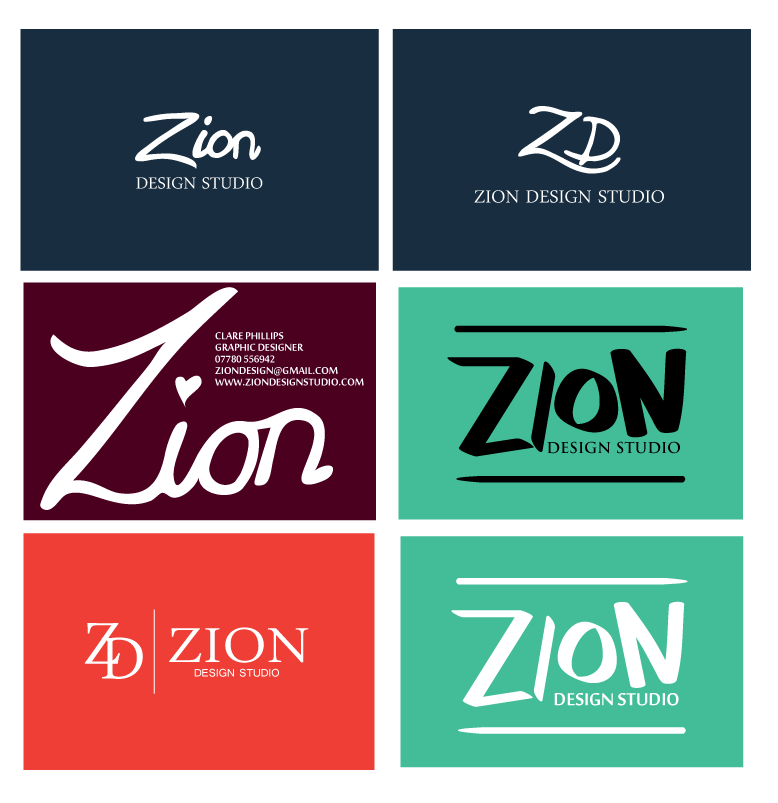
These are some of my developed ideas for my business card.

After getting some feedback on my ideas I decided to work on some alternative designs.
These are my latest business card concepts.


I am getting closer to creating a business card design that I am happy with. I like the bright bold colour schemes of these latest designs, but I feel that they might be a bit too busy.


Monday, 30 March 2015

Malibu Packaging Experiments

In our lesson today we worked on collage techniques in Photoshop.
I created this design which may be suitable for my Malibu packaging.


I began by creating overlapping leaf shapes on a layer and used the multiply effect to separate the shapes out into sections. Once I had my shapes, I used different imported textures to fill in sections of my shapes. I adjusted the colours by desaturating the shapes and adjusting the hue and saturation. I added the flower and coconut shapes (black vector shapes) and filled them in with different textures. I added a watercolour background. I am quite happy with the outcome and think the concept could work in the other Malibu flavour ranges.


 I then thought about whether this technique could be used to create a background pattern for my bottle. 
Here is the pattern I created. 


Tuesday, 24 March 2015

University Leaflet

We were given the task of creating a leaflet to advertise a new course at Farnborough University.
We were given the content, including fonts, images, logo and colour scheme to use.
I began by cropping around the edge of my photo using Photoshop and then creating the layout using Indesign.
Here is the outcome.


Thursday, 19 March 2015

Easter Leaflet for Church

I put together this quick and simple Easter leaflet using some of the drawing techniques I have learnt on my course. I drew the simple images using the pen tool and added a subtle drop shadow for depth.


PRESS PAUSE PLAY DOCUMENTARY

PressPausePlay focuses primarily on the music industry. In what way do the issues resonate with you as a designer?

The film highlighted the fact that these days everyone has the potential to be a film maker, photographer or producer. In the design industry, access to software such as Adobe Creative cloud, has meant that now literally anyone can afford to access professional creative software. Not only that, but now there are a wealth of online tutorials available, meaning that anyone can teach themselves how to use software which was once only known by the professionals. The secrets of the design industry are freely available to all.  Also, there is so much free software online now which make designing so much easier for the novice. ‘Picmonkey’ for example means that even for people who don’t want to spend time learning how to use the professional software can still create modern and personalised designs in minutes. Similarly, developments in technology now mean that anyone can build their own website using platforms such as ‘wix’ and ‘wordpress’.  This has massive financial implications on the graphic designer because many small businesses are opting to bypass the creative person and create logos, business cards and websites themselves. The downside of this trend is that we see a lot of bland design that lacks uniqueness. Consequently, businesses lack a sense of identity and look like every other one.  So, while the design industry may be experiencing a decline of work coming from the smaller businesses, who are looking to save money, some businesses who want to stand out above all the mediocracy will be willing to pay a professional graphic designer for something unique.

Advances in technology and software have also meant that graphic designers can produce accurate work, more quickly than in the past. The negative side of this however is that designers have become too reliant on technology and the more traditional design skills, like photography, painting, drawing, etc. are becoming rarer.  Also digital artwork can have an almost, boring, sterile precision and lacks the imperfect, vulnerably quality of handmade art. The challenge for the designer is to stand out from the rest and demonstrate originality and talent that clients will be willing to pay for.

While the evolution of the internet has removed the cap on creativity and made it accessible to all, it has also opened up new opportunities for the designer that had never existed before. Opportunities for the designer to work for themselves from the comfort of their own homes, rather than working for an agency have increased.  Clients are able to contact designers directly, cutting out the agency in the middle. This of course offers flexibility to designers, potential to specialise in their areas of interest and work on projects that they really enjoy. Designers are able to utilise the internet to network easily and create an online brand very quickly. The down side to this is a lack of regular consistent income, but the potential to earn more if the designer is able to stay ahead of the rest and to use all the right networking tools to their advantage.


Some have tried to argue that the music industry is dying out. People have also begun to question the future of the graphic design industry. I believe that if we, as designers, continually look for new and creative ways to adapt to the changes and use them to our advantage, there will always be a future in graphic design, albeit a different one than we might have expected.